Snapped
Crime · Documentary
Creator: Zak Weisfeld, Stephen Land

“No Witnesses. No Leads. No Problem.”
Forensic Files is streaming on Prime Video in India.
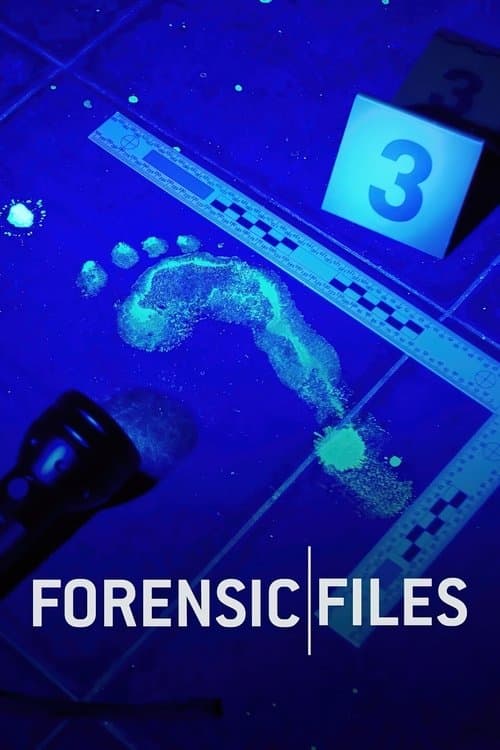
Forensic Files is a 1996 English crime series. It spans 14 seasons and 400 episodes, rated TV-14. The cast is led by Peter Thomas. It holds an IMDb rating of 7.9.
Real crimes, disease outbreaks and accidents around the world are solved by experts using scientific laboratory analysis which helps them find previously undetectable evidence. Brilliant scientific work helps convict the guilty and free the innocent.


A young mother is murdered after years of domestic abuse. There are clues at the scene: bloody footprints and DNA from the victim’s rape kit.

Threatening emails, a missing person and an abandoned truck lead police to a home where they believe a murder was committed. The evidence is overwhelming and investigators are sure they have the killer. What they don’t have is the body of the victim.

In 2000, Kristine Fitzhugh failed to show up for her music class and her husband Ken found her dead at the bottom of the stairs of their Palo Alto home. Upon further investigation, luminol reveals evidence of murder in the kitchen. As detectives investigate the crime further, they uncover a long-held family secret that provides motive.

As she left choir practice, a woman was gunned down in the church parking lot. Her husband became the prime suspect – particularly when police learned he found out just a month earlier that his wife had been cheating on him for three years.

In 2008, Illinois emergency response came upon a garage fire and a man was found crushed beneath a truck. Upon first glance, the victim was the homeowner Ari Squire. Investigators turned to forensic science to determine if they were dealing with a tragic accident or a carefully orchestrated murder.

In 2007, the Florida mobile home of Effie and Michael Ratley catches fire and Michael heroically rescues his wife and infant son. A month later, his wife is found beaten to death in a bedroom of his parents' home. The cut window screen points to an intruder, but the lack of supporting evidence compels investigators to look within.

In 2005, David Castor suffered a slow, agonizing death over a period of days. His wife Stacey maintained it was suicide, even though it was done with antifreeze. Police were skeptical, especially when they learned Stacey's first husband Michael Wallace died when he was only 38 years old and she refused to consent to an autopsy.

In the 1990s, a dismembered body is dumped on the side of the New Jersey Turnpike and before police realize it, bodies are turning up between two states. The killer's methods involved dismembering the bodies and wrapping the parts in plastic bags, which were carefully washed to remove all incriminating evidence. The killer eluded capture for almost ten years and then new technology revealed fingerprints no one knew were there.

In 2006, Jackson, MS, resident Avis Banks and her unborn child were brutally murdered in her garage and discovered by her fiancé Keyon Pittman. Police learn Pittman was having affairs with other women and he became the prime suspect... that is until a man comes forward who not only believes he owns the murder weapon, he also knows who used it.

In 2000, when teenager Tara Munsey goes missing after a work shift at a Virginia restaurant, it is unknown if she ran away or if she was the victim of foul play. Everyone's worst fears are confirmed when a body is found at the bottom of an isolated ravine. Investigators scoured the crime scene, hoping to find enough evidence to identify the killer.

In 1989, the bodies of Joan Rogers and her two teenage daughters were found floating in Tampa Bay. The water washed away any evidence, but police hoped a handwritten note found in the victims' car would lead to the killer, so they posted huge copies of the note on five highway billboards.

In 2003, Tiffany Rowell and three of her friends were brutally murdered in their affluent Clear Lake, TX, neighborhood and the crime scene yielded little evidence. The next-door neighbors had seen two young people dressed in black walking nearby and their descriptions were used to create composite drawings, which become a key element in solving the crime.

In 2008, college co-ed Jenna Verhaalen was found dead in her Bryan, Texas apartment and petechial hemorrhages in her eyes indicated that she was strangled. The victim's boyfriend, a neighbor and the apartment maintenance man are all suspected, but it takes DNA evidence to identify the killer.

In 2003, Rebecca Barney and her soon-to-be ex-husband Fred were found shot to death in their Tulsa, OK, home, which had been set on fire. After the fire was extinguished, Kenneth Maxwell, who was the man who had called 911 to report the fire, was also found shot dead in his car. Only the computer had been taken from the Barney home and with it, seemingly the means to identify the killer.

In 2003, Kathy Lorick was raped and murdered on a Concord, California jogging trail in the middle of the day while talking to her husband on her mobile phone. The leads from Kathy's cell phone records and search dogs go nowhere. Nine days later, a witness tells police about a chance encounter.

In 2008, Colorado real estate developer Alan Helmick was found shot to death at home. His wife Miriam became the prime suspect. Police had a wealth of evidence against her, but it is circumstantial. The case will turn on a .25 caliber bullet fired 20 years ago from the now-missing murder weapon.

In 2005, the body of young mother Summer Baldwin was found in a suitcase in a Texas landfill. The suitcase leads investigators to a suspect, Rosendo Rodriguez, and the forensic evidence against him was formidable. Further evidence leads them to teenager Joanna Rogers, who had gone missing in 2004. Upon extensive search of the same landfill, Rogers' decomposing body was also found in a suitcase.

In 2001, Michelle Harris went missing from her Owego, NY home. Since they were going through a contentious divorce, her husband Cal was a suspect, as well as several other men that Michele had been in contact with before her disappearance. But, no arrests were made until one of the men made an incriminating remark.

In 2004, nursing student Tamika Huston went missing from her Spartanburg, SC home. A tip led detectives to her car and they find an unknown house key that could help solve the case. Further investigation leads to the only other clues: a fingerprint and a code.

In 2002, funeral director Lonnie Turner, Sr. was found shot to death in his Navasota, TX home. His son Lonnie Jr. became the prime suspect, particularly after it was discovered that the murder was committed with his gun. However, he had an alibi for the time of the murder. Later, detectives found a mask near the crime scene and DNA evidence may lead to the killer.

In 1993, young mother Tammy Tatum was found sexually assaulted and murdered in her Longmont, CO apartment. Police initially suspect her estranged husband, but did not have enough evidence to charge him and the case went cold. Three years later, another young woman was raped and police suspect the cases may be related. Despite meticulous washing of the crime scene, a single hair remains to lead authorities to the culprit.


In 2004, Mary Ann Clibbery was found brutally murdered in her Illinois business and investigators had to determine if this was a robbery gone wrong or a calculated murder. The evidence at the scene told police what happened and they got a huge break when evidence from the murder was found on top of a nearby frozen river.

In 2006, Texas real estate agent Sarah Anne Walker was found brutally murdered in a model home. Weeks later, a witness came forward who may have seen the killer and police used forensic hypnosis to help him recall every detail of the man's appearance. His description was used to create a composite sketch, which police used to draw the killer out of hiding.

In 2003, St. Cloud teenager Jason MacLennan returned home after a night out with friends and discovered his father Ken's body lying in a pool of blood. There were shoe impressions outside in the new-fallen snow; because the victim's wallet and watch were missing, the motive may have been robbery. But before making that determination, police needed to find out who had the most to gain from his death.

In 2006, Nevada politician Kathy Augustine died mysteriously during a hard-fought re-election campaign and the medical examiner could neither isolate the cause of death, nor explain the tiny puncture wounds discovered during the autopsy. Upon deeper analysis, investigators focus on her husband Chaz Higgs, a critical care nurse who had ready access to succinylcholine.

In 1996, Virginia Beach police arrive at the Makdessi apartment to find Elise Makdessi and her lover Quincy Brown dead. Elise's husband Eddie had reported that he killed Quincy Brown in self defense after Brown had murdered Elise. Eddie gave the police a videotape Elise had made a week before, alleging that she had been the victim of sexual harassment and assault while in the Navy. Investigators found evidence that her allegations may have been part of an elaborate scheme for financial gain. Hoping to separate fact from fiction, they turned to forensic science.

In 1999, Patrick McRae was found dead in his Des Moines home and the crime scene was awash with blood. Analysis showed it had come from two people, one of whom was female. The male DNA was McRae's, which meant the killer was a woman. Leads dried up and the case went cold until a suspect arrested for drug possession offered police a deal, and told a bizarre tale of an exotic dancer named Andrea Morris who listened to the voices in her head.

In 2000, the body of exotic dancer Rachel Siani was found beneath a New Jersey bridge and investigators wondered if she had committed suicide. Evidence at the scene proved not only that she'd been carried to the bridge and thrown over the side, but also that she was alive when she fell. Police look at customers at the gentlemen's club and co-workers who had vendettas against the victim.

In 2000, construction manager Darrell North was found dead in his work trailer in Ft. Worth, Texas. When investigators arrived, they found that he had been stabbed 46 times, described as overkill and indicating a personal relationship between the victim and the attacker. Police hoped that, during the struggle, the killer had left some of his own blood and his DNA behind. Their challenge was to find it. Forensic science points to an unlikely suspect.

In 2000, Judy Southern arrived home from work and was shot by a gunman waiting within. Her husband Allen arrived shortly afterwards, called 911 to report his wife had been shot and drove her to the hospital. She died on arrival and the investigation focused on her husband Allen, but forensic analysis and a suicide note found at the scene pointed to the killer.

In 1986, Gary Dale Larson was stabbed to death in his Edmond, OK, home and then the killer sexually assaulted Larson's girlfriend Janet Haynes. Hayne's story seemed farfetched: The perpetrator was wearing only underwear and gloves broke into the house, stabbed Larson to death, then raped and terrorized her for hours afterwards. But, the evidence at the scene supported her story, and investigators turned for help to the FBI and their criminal profilers.

In 1991, Dorothy Donovan was murdered in her Dover, DE home and police are skeptical when her son Charles Holden stated that she was murdered by a hitchhiker he had picked up. Their suspicions were heightened when he refused to take a polygraph test and they turned to forensic science. Would the blood and fingerprint evidence at the crime scene support Charles' story or prove his guilt?

In 2001, Ginger Hayes and her infant son Nicholas were abducted during a carjacking and the crime had been reported by a witness within minutes of occurrence. 45 minutes after the kidnapping, When Ginger and Nicholas were found 50 miles away, Ginger had been beaten to death, but Nicholas was still alive. Further analysis of Ginger's car and evidence at the scene where Ginger was found both led to her killer.

In the early hours of a morning just before Christmas, a college co-ed was abducted from the parking lot of her apartment. Her body was found later that day; she'd been sexually assaulted and then shot at point blank range. Eight long years passed and then a pair of running shoes and a cell phone breathed new life into a very cold case.

A young woman is found dead in her apartment. There's little evidence at the scene, leads don't pan out and the case turns cold... until police discover a link between their prime suspect and an unsolved murder committed six years earlier in different state.

When a college student is reported missing, police believe their investigation will be like countless others, and she'd turn-up a few days later. But when they discover blood spatter in her boyfriend's bedroom, blood spatter someone had gone to great lengths to conceal, they know this case is going to be different.

A serial rapist is on the loose in a Texas town. No one knew where he'd strike next, but the audacity of his attacks and the escalation of violence against his victims made finding him imperative.

The victim has been stabbed more than thirty times, and the crime scene is awash with her blood. Near her head, police discover a distinctive button with strands of thread still attached. If they can find the owner of the shirt the button came from, they'll also find the killer.

A young woman attends evening church services... then disappears. When her abandoned car is found, the tank is empty and a gas can she kept in her trunk for emergencies is missing. Eyewitnesses place her at a nearby gas station, getting into a van, but their descriptions of the vehicle don't match. Three days later when her body is discovered, the search for the driver of that van intensifies.

When a nine-year-old girl goes missing, police and volunteers spend weeks searching for her. A psychic's vision leads to a field where her body is discovered, along with what investigators hope is enough evidence to help them to also find her killer.

Digital enhancement of security camera video shows that what appears to be a casual encounter is actually a forced abduction, leading to murder. The perpetrator's M.O. is remarkably similar to another murder which occurred five months earlier, 15 miles away. When investigators learn the crimes might not be isolated or random, they also realize a serial killer may be on the loose.

The woman had been sexually assaulted, stabbed repeatedly, and left for dead. She survived, and gave police a detailed description of her attacker. When someone who fit that description practically turned himself in, police were sure they had their man... until the DNA evidence proved them wrong.

The victim was a self-made man who never minced words. Perhaps he was murdered by a disgruntled client or employee. Perhaps the racy photos in his safe held the clue to solving the crime. Or perhaps with the help of the IRS, investigators could follow the money and find the killer.

A family vacation turns into a nightmare when the wife is found face-down in the lake. There are no witnesses and little conclusive evidence to help police determine if they're dealing with a suicide, an accident, or something more sinister... until a forensic pathologist uses a groundbreaking technique to discover the truth.

The woman in the back of the truck was flailing her arms, screaming. They thought she was doing something dangerous for the fun of it. But when they found a jacket near a pool of blood, they knew what they'd seen wasn't a joy ride; it was an abduction.

When court clerk Peter Porco doesn't report to his work in November 2004, a courts officer is ordered to the Porcos' family home in Bethlehem, NY. Inside the home, he finds murdered Peter Porco and his barely alive wife Joan who had both been savagely attacked with a fireman's axe. Eventually, a DNA sample may lead to the killer.

Detectives think they've solved a murder when they find the weapon and victim's blood in a man's flat, but the evidence may have been planted.

A serial bomber was on the loose in Illinois. Two churches had been bombed and one person was killed. Investigators had to capture the criminal before he struck again and they hoped to catch him by following a thin copper wire.

There was no clear reason for a young, healthy college student to be dead. But when the medical examiner discovered the tiniest of clues during the autopsy, investigators were able to uncover the mystery filled with betrayal and revenge.

The victim had been stabbed more than a hundred times, leaving her bedroom soaked with blood. Even though her body was positioned in a suggestive way, she hadn't been sexually attacked. Was this a sex crime, or was it a random act of violence?

On Christmas eve 2005, the corpse of a black male is found burning near Baltimore. He's eventually identified as 26-year-old Wesley Person. Distinctive building materials from the 1930s found near the body play a crucial role in solving this case.

Doctors don't know why a young scientist is gravely ill. When tests finally reveal the cause, it's too late to save him. Police hope that lab analysis of his hair, showing when attempts were made on his life and what was used, will lead to the killer.

A bullet-riddled car, a missing driver, and no witnesses. Was this an ambush or a random attack? Had the victim been abducted or was she dead? The answers lay in a unique clue so tiny it was measured in millionths of a meter.

Even though their daughter had run away before, she'd always come back. Her parents were sure this time would be no different, but they were wrong. Workers discovered the teen's half-naked body on the side of the road; her throat had been slit. Police hoped the single foreign hair found in a defensive wound on her thumb would lead them to the killer.

In little more than a month, two women who lived in the same apartment complex were brutally murdered. The similarities of the crime scenes led police to conclude they were dealing with a serial killer who harbored an intense hatred of women... and they had to find him before he struck again.

When a college co-ed vanished without a trace, her fellow students were concerned about her safety and their own. Weeks later, the body of an unknown female was discovered 700 miles away in the ashes of a barn fire, and an alert police officer realized the two crimes might be connected.

The victim was well liked and successful, which made the brutality of the crime even harder to understand. In the final moments of her life, she'd written a name on the wall, presumably that of the killer – in her own blood. But this wasn't an open and shut case and, in order to solve it, investigators would have to read between the lines.

An assistant manager of a Florida steakhouse is stabbed to death. It appears to be a robbery gone wrong, but a bloody fingerprint reveals that he knew his killer.

In 1985, Julie Estes, then 21, was abducted from her late-night job at the Southside convenience store. Her body was found the next day, she had been raped and strangled. Her murder went unsolved until 2003 when it was reopened by the new cold case squad at the Jacksonville Sheriff's Office, who look to DNA evidence to try to nail the killer.

In April 2002, a wild fire in a secluded parking lot leads police to discover the dreadful homicide of David Nixon, with the suspect's image caught by security cameras.

Respected surgeon Brian Stidham was stabbed to death in the parking lot next to his office. The most likely suspect is seen having dinner in a restaurant at the time of the murder. But a cryptic conversation leads police to believe that, while the suspect may not have wielded the knife, he could very well have hired the man who did.

In 2007, Brian & Beverly Mauck were found dead in their Graham, WA home. The killer obviously spent a great deal of time at the scene, wiping away his fingerprints and obscuring shoe impressions he’d tracked through blood trails on the floor. But in the process, he created new evidence which was just as incriminating.

Terrified, the young girl hid in her bedroom while her mother, Crystal Perry, was attacked and stabbed to death in her home in Bridgton, ME, on May 12, 1994. Investigators had a wealth of evidence: shoe impressions, distinctive blood drops, and the killer’s DNA. What they didn’t have was a basis for comparison.

On December 10, 2003, a gunman opened fire as a family of four entered their home, killing two and wounding the others. He’d pulled open a few drawers to make it look like a robbery, but the scene was clearly staged. When police pieced together the clues, they discovered an unlikely suspect and a carefully orchestrated plot.

It was classic “overkill.” Barbara Mullenix, found floating in the harbor of an upscale yacht club in Newport Bay on September 13, 2006, had been stabbed more than 50 times. Her ex-husband and daughter are missing, and investigators turn to forensic science to determine if they’re searching for victims... or perpetrators.

On May 20, 2001, 20-year-old state park employee Carrie Nelson was beaten to death in the park office while working alone in the middle of the afternoon. There’s a wealth of evidence at the scene, but it doesn’t implicate the prime suspect, it clears him. Six years -- and 600 leads -- later, advances in DNA technology enable investigators to identify and convict the killer.

Foul play is suspected when Fort Worth factory worker Glenda Furch disappears in September 2007 after completing her shift. Evidence suggested she had been bound, sexually assaulted and murdered. Afterwards, the killer spent hours at the crime scene, wiping away his fingerprints and disposing of everything which might incriminate him, including her body. Police now face a daunting task: They not only have to find the killer, they also have to find the body of the victim.

Joshua Ford and Martha Crutchley spent Memorial Day weekend at the beach, and then they simply vanished. A week later, police would get an unexpected lead from a robbery in progress, and the evidence they found helped solve a crime of unparalleled violence and brutality.

Whoever stabbed a young Texas mother to death had also savagely beaten her 4-year-old daughter. Police had a suspect, but not enough evidence to tie him to the crimes. It would take 15 years and advances in DNA technology to bring the killer to justice.

In 1995, Palm Beach waitress Denise O'Neill is abducted and murdered. Her neighbor, Luis Caballero, arouses suspicions by his odd behaviour towards TV crews covering the crime.

In 2007, Shamaia Smith disappeared from the strip club she worked at in East Hartford, CT. Police look at various customers of the strip club, but focus on local businessman Kenneth Otto when there were inconsistencies with his story. Upon search of Otto's rural property, cadaver dogs find something in a fire pit.


When a young girl was found dead, police quickly arrested the most likely suspect. But cutting-edge technology from NASA enabled a forensic odontologist to prove the wrong man was behind bars. With the killer still on the loose, the investigation was far from over.

It's usually easy to determine how a criminal entered the crime scene. But in this case, it was far from clear. It looked like the killer vanished into thin air...and perhaps he had.

When a young fireman died from what appeared to be serious but undiagnosed heart disease, his family and friends were devastated but they had no proof of foul play. Then they learned that, six years earlier in a nearby town, a young police officer died in the same way. The men had one thing in common: at the time of their deaths, they were married to the same woman.

Security cameras in a casino tracked a young woman's movements until shortly before she disappeared. She was never seen again, but through the evidence she left behind, she was able to tell investigators what happened to her and who was responsible.

It was one of the most unusual cases in forensic history. Investigators had to find a way to solve a murder case with evidence which consisted of a squashed tomato found at the crime scene, and tiny, pinpoint reflections of light in a photograph. Would it be enough to catch a killer?

When a dedicated, well-respected teacher disappeared, police had to determine if she'd gone on vacation without telling anyone, or if she was the victim of foul play. Investigators turned to forensic science, hoping to find the answers they needed.

Seattle police had no suspects in the violent murder of post-grunge singer, Mia Zapata. More than a decade would pass before the evidence collected by an extraordinarily prescient medical examiner could be used by forensic scientists to identify the killer.

A Michigan State University grad student disappeared and was presumed dead. With the help of a professor of geological sciences, police hoped to get the "dirt" on her killer.

How unlucky could one man be? His wife had taken her own life, and his college sweetheart had killed herself in much the same fashion fourteen years earlier. Investigators had to determine if this was a bizarre coincidence, or an attempt to get away with murder... twice.

In 1996, 54-year-old Gayle Isleib was ambushed in her Manchester, Connecticut driveway and shot to death. During their investigation, police learned that her 25-year-old co-worker Tyrone Montgomery was in love with her and that she had spurned his advances. They now had to determine if love had turned into obsession... and a motive for murder.

The victim had been sexually assaulted and stabbed to death on the beach, just ten yards from the hotel where she was staying. A pair of men's tennis shoes was discovered near her body. Police were sure that if they found the man who fit the shoes, they would also find the man who committed the crime.

A 13-year-old girl went missing from her Colorado home, and the only evidence the kidnapper left behind was three fingerprints on a window screen. Two years later, a latent print examiner, new to the county and the crime lab, changed the course of the investigation by sharing a little-known fact with his colleagues.

A brutal murder, lots of suspects, and conflicting evidence but the forensics were clear on one thing - the killer knew his victim and that alone gave investigators a head start.

A serial killer was on the loose and police had to find him before he struck again. Their most promising lead was an unusual one: a bloody fingerprint on the body of one of the victims.

On Halloween night 2004, Adriane Insogna and Leslie Mazzara were brutally murdered in their Napa, CA, home. The killer was not seen by their downstairs roommate, but he left his DNA behind in some cigarette butts and a groundbreaking test revealed his race and even the color of his eyes and hair.

After the suspect was convicted of arson and murder, he steadfastly maintained he did not commit the crimes, but he was sentenced to a minimum of 25 years in prison. He had no money, no lawyer and only a fifth grade education, but he never gave up. He turned to the law books in the prison library and television programs about forensic science, and set out to prove his innocence. [also marked as S12:25]

A woman was brutally murdered in her home, and the only witnesses to the crime were the family dogs. An expert in canine behavior was convinced the killer knew both the victim and the animals, and he was determined find out exactly what the dogs had seen.

The killer probably hoped to cover his tracks by staging the crime scene. But investigators saw through the attempt almost immediately, and they turned to forensic science to learn what really happened that night. [also marked as S12:E19]

A 6-year-old girl ran and hid when she saw her grandmother being beaten to death, but the man followed her, beat her and assaulted her. The girl said he was her Uncle Clarence, and he was convicted because of her identification. She recanted her testimony years later, but the court denied Clarence's petition for a new trial. His wife was convinced he was innocent, and decided to conduct her own investigation to prove it.

In 1984, the body of college co-ed Laura Salmon was found on a Georgia farm, covered with her own denim jeans as well as the jeans of the killer. Investigators had plenty of suspects, including former boyfriend David Kyle Gilley, but no conclusive evidence linking any of them to the crime. More than a decade later, sophisticated technology would breathe new life into a case grown cold with the passage of time and implicate her killer.

The body of an attractive young woman was found a mile from her abandoned car. Police were especially concerned when they realised the victim had come to them for protection just two weeks earlier, after a road rage incident. Concern turned to dread when the evidence began to point not to an aggressive driver, but to one of their fellow police officers.

In 1969, 25-year-old phone operator Diane Maxwell is raped and murdered by a black man. Her brother promised he'd find out who was responsible and bring the killer to justice. It would take more than thirty years, but the young man kept his promise and, in doing so, brought closure to his family.

The crime scene was especially violent: A husband and wife had been shot to death in their bedroom. At first, investigators thought their 16-year-old daughter was lucky to have escaped unharmed... but after a while, they wondered if the reason she was alive had more to do with careful planning than good fortune.

A young, attractive hairdresser was sexually assaulted and murdered in her own beauty salon. The evidence at the crime scene didn't match any of the suspects and, after the initial investigation, the case went cold for ten years. Then a witness who had been silent for more than a decade decided to do the right thing.

When two women went missing and were later found brutally murdered, police wondered if they were victims of a hate crime; the women lived together and were politically active, outspoken advocates of gay rights. But the motive turned out to be something age old, something with which investigators were all too familiar: greed, fueled by obsession.

A human skeleton was discovered in the North Carolina marshlands and, when investigators learned she'd been dead for 18 months, they knew it would be difficult to find out who she was, much less who killed her. A forensic anthropologist was able to determine the victim's race, age and height, but it would take an inventive computer consultant to give her a face and a name.

After shooting his victims in the head, the killer staged the scene, placed the incriminating evidence into a plastic bag and tossed it into the river. Instead of floating downstream, it became entangled in overhanging branches. Days later, when police found it, they hoped clues to the killer's identity and the solution to the crime were "in the bag."

In a tragic twist of fate, just days after the woman sold her home and moved to a modest trailer, a fire took both the trailer and her life. But the autopsy proved this was no accident. It was arson and murder. Investigators had to determine who wanted the woman dead... and why.

A security guard disappeared from his post without a trace; his remains were found a year later in a remote camp site. More than a decade would pass before a phone call breathed life into the cold case, and a paint smear on the bottom of the victim's boot helped scientists determine what happened during the last hour of his life.

A college senior was found raped and murdered near an unpaved footpath used by students to walk from one side of campus to the other. Five years earlier, a student was assaulted and killed in her off-campus apartment and, a year after that, another student was killed in almost the same way. Police feared a serial killer was on the loose and they needed to determine what – or who – these women had in common.

Episode list not loaded for this season.

Episode list not loaded for this season.

Episode list not loaded for this season.

Episode list not loaded for this season.

Episode list not loaded for this season.

Episode list not loaded for this season.

Episode list not loaded for this season.

Episode list not loaded for this season.

Episode list not loaded for this season.

Episode list not loaded for this season.

Episode list not loaded for this season.
Movies and shows similar to Forensic Files — open any to see where it streams in India.
Crime · Documentary
Creator: Zak Weisfeld, Stephen Land
Documentary · Mystery
Cast: Laurence Fishburne
Documentary
Cast: William Shatner
 Series
Documentary
Creator: Erik Powers
 Series